Tampilkan postingan dengan label benefits. Tampilkan semua postingan

Cleaning Out the Links Part 3

We start out on this Monday morning with 18 common e-mail mistakes from US News and World Report via Yahoo! Finance (H/T Sarah). I can tell you from the experience of receiving e-mails (in both my professional and personal life) that people hit reply all way too often when they just mean to hit plain ole reply.

Next, from FINS we have Goldman Sachs updating their interview tips via a nifty little video (H/T Wendy). The most important advice, in my opinion, is the last point: "At the End. Ask two or three questions about the company or about the interviewer's view of broad industry trends. Don't ask about salary and benefits. You'll have plenty of time for that once you get an offer. And, of course, e-mail a thank you note. It's a classy touch."

ABC News is next with some things not to do during an interview such as, well, bringing mom. Some of these are priceless.

Next, from USA Photos Pictures Blog is a list of the top ten worst jobs in the United States...with pictures of each.

Lastly, from SIFMA, a list of what the positions really mean in simpledetails.

More About Disgruntled Workers

Last week we talked about Steven Slater here at the Welcome to the World of HR blog, but obviously he's not the only disgruntled worker out there. Let's take a look at a few other articles:

First we have the other "famous quitter" of this past week, "Jenny" who quit her job via job erase board "leaked" to The Chive. The whole thing ended up being a farce, but Jenny became as big of a cult hero as Slater for a few hours. What does it show when Slater and "Jenny" become "working class heroes"? People are frustrated at their current jobs.

With that in mind, Slate tells us that employers should be glad that candidates won't take their crummy, low-wage jobs, even in a bad economy: "Hiring is a negotiation between employers and employees over the terms at which they'll agree to come to work—wages, benefits, working conditions, length of commute, relocation requirements. Maybe some of these employers just aren't offering terms that are good enough."

TLNT follows by telling us that even people who have jobs aren't ready to settle for those crummy, low-wage jobs and that 40% of workers are going to be ready to find a new job this fall.

Lastly, we have a Wall Street Journal Careers Q&A where someone asks about quitting a job...before they've even started.

The lesson of all this: make sure that your current co-workers and you candidates are, well, "gruntled"

Unemployed...and Frustrated

On this Good Friday, we bring you some good links that are not so good if you're unemployed:

It's frustrating when you go through a few interviews and don't get a job offer. But one person went through 52 interviews at Goldman Sachs and got only one job offer according to Here Is The City (H/T Wendy). Wow

How many people are taking jobs right now they are overqualified for? But it doesn't mean they aren't really happy to be employed according to the New York Times (H/T Sarah and picture from the NYT article)

There is one time when "any work" is worse than "no work": unemployment benefits and the Christian Science Monitor via Yahoo! explains (H/T Wendy)

And Tom Delay, you have egg on your face after saying that people are unemployed because they want to be. Details of that non-PC and non-true statement from Huffington Post via Yahoo! (H/T Wendy)

When Personal Information Gets Out

My company sent around an e-mail today that let us know our benefits administrator inadverently sent out personal benefits enrollment information (including Social Security numbers) to the Human Resources department of another client.

Now that the damage has been done, what can the company do to make it right? The benefits administrator is sending a letter home to all of us explaining the mistake and also offering one free year of credit monitoring. But is that enough?

One co-worker who had learned about this type of situation in her past job said that this was insufficient: "Thieves sit on the information for a while due to the fact they know people will be monitoring and then start using when they think the coast is clear--usually after one year."

Now "luckily" this information was only sent to a another Human Resources department and the e-mails were supposedly all deleted without being read. But what if this was accidentally (or purposefully) sent to people who were not as honest? Not only is the associates' information at risk, but their families who are enrolled in the benefits are at risk as well.

This just goes to the heart of the issue: make sure that all safeguards are in place to assure that your employees' personal information never gets into the wrong hands. And if it does somehow get into someone else's hands, you need to make sure there are measures in place to correct the situation.

Do you think that our benefits administrator has done enough in this situation? What do you think they could do more (another year of monitoring, etc.)? What measures does your company have in place for this type of situation?

Losing Disability Benefits Because of Facebook/Chippendales

The Lede from The New York Times had this as a title: "Depressed Woman Appears Happy on Facebook, Trouble Ensues."  When you read through the story (first reported from CBC News), it's another lesson to employees to watch what you post on sites like Facebook:
A 29-year-old Canadian woman who says she’s too depressed to do her job claims that her employer’s insurance company stopped paying her disability benefits because she posted some photographs of herself on Facebook in which she appeared to be happy.
Nathalie Blanchard, who has been on sick leave from an IBM office in Quebec since “she was diagnosed with major depression” 18 months ago, called her employer’s insurance company, Manulife, to ask why she had stopped receiving her monthly check. Ms. Blanchard says that an insurance agent informed her that photographs she had posted on her Facebook account — showing her apparently enjoying a Chippendales show, her birthday party and a beach vacation — proved that she was not depressed
Now I can't see how this can stand (but then again I don't know the Canadian court system that well). I'm not sure an insurance agent is qualified to tell if a woman is depressed or not based on photos she posted on Facebook. And if she was enjoying Chippendales, her birthday and a beach vacation, isn't she a normal human being. Let's just say things got worse for Blanchard after this...
[Her lawyer, Tom Lavin] told The Gazette, a Montreal newspaper, that his client’s mortgage insurance was cut off because someone alerted her financial institution to the supposedly damning Facebook photos. “That forced her to sell her house because she can’t afford to pay her mortgage,” Mr. Lavin told The Gazette, “her credit has gone down the tubes and her reputation has been damaged. She’s not having a good time.”
If she wasn't depressed before...Ouch.

Yankees Win, thhhhhheeeeee Yankees Win (and a few HR articles)


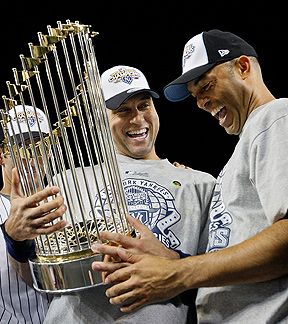
We don't hide our baseball loyalty very well here at the Astron Solutions blog. We're (Myself, Jennifer and Mike) big Yankees fans and we're gloating today after the Yankees took home #27! They were able to overcome controversy, weak areas and past failures to finally capture the biggest prize.

Love or hate the Yankees, you have to respect how well-run their organization is, regardless of the money. They put the right people in the right situations to succeed and pushed guys when they could be pushed. They stuck behind guys like Alex Rodriguez who had trouble outside the workplace and allowed him to succeed at the workplace. It's a good model for HR to replicate.

A few HR articles for you as I get ready to head to the Canyon of Heroes tomorrow:

  • Wired has an awful story about a woman losing her job because of an error in the FBI criminal database. Ouch.
  • Lastly, word today from The New York Times on the House of Representatives extending the jobless benefits.

Don't Report Your Time Off?

WorldAtWork recently posted a blog entry titled: "Vacation time: Is It Time to Stop Tracking?" It's an interesting question and one which has a lot of different answers depending on who you ask. From WorldAtWork:
Many companies over the years have migrated from siloed leave policies that designate a specific number of days for vacation, sick leave and personal time off to paid time off (PTO) banks programs that provide a total set number of days off that employees can use for any reason. Newer, even more flexible, programs now provide employees with more informal personal time and vacation arrangements with their managers when it suits them, guided mainly by their ability to perform their jobs successfully.
Now this is much like an honor system, and like any honor system, you have the chance of abuse or free riders. But the idea makes sense. With people permanently tethered to Blackberries and the internet, the job doesn't have to stop when you leave the office. If people don't abuse the system, they'll get their job done and be happy, which should increase productivity even more. I once interviewed for a job that was run like this, though they expected you to make up for the time you missed...but you could miss as much as you wanted.

Some companies allow you to trade time off credits, work a Saturday/Sunday to get another day off, or other similar ways to make time off more flexible for the employees.

The problem here is this is not for every job. You still need to know when people are going to not be at their desks--especially in service-oriented companies--and reporting time off (or at least letting their managers know ahead of time) is one way to accomplish that. This also can only occur at companies where the management and the employees feel secure with one another. Employees have to feel comfortable enough with taking the time off (since there are issues with them feeling that way as it is) and employers need to feel comfortable enough in the fact the job will get done and the person will not abuse it.

But in the world of increasing attachment to the office, allowing an employee to have the ultimate "flex" time off doesn't mean they'll truly be away from the job and could be another "benefit" that separates your company from the rest when recruiting new employees.

Question to the audience: do any of your companies do this? what are your opinions on the subject?

What I'm Hearing...Customized Rewards

Over the next two months, I'm going to be on the road giving presentations on total rewards. Hopefully among my travels I'll come across some blog worthy discoveries!

One of the key themes of my presentations is that, in today's economy, employers can't rely solely on base pay and benefits to attract and retain employees. Rather, total rewards is the new focus. Total rewards includes pay and benefits, and also adds work/life balance, career advancement and development, and performance management and recognition into the mix. Moving forward, organizations will have to tap into all 5 of these areas, and customize their blends to meet employee needs, in order to be successful.

In light of this I found two separate conversations I had yesterday quite interesting. In both instances, the employees' employers were trying to do something nice to reward their employees by tapping into the 3 new elements of total rewards. In both cases, the employees knew how much their company was spending on the "reward," and would rather have had the cash. They felt like their companies were forcing the "reward" on them.

Customization of rewards is key moving forward. To be done right, however, customization must be done from the perspective of the employee, not the employer. To truly reward and motivate, the compensation elements must be what the employee wants and needs, not what I as your manager think you should have because I happen to like it.

How much rewards customization does your organization use? Is it truly customized? How will your rewards programs change moving forward?

Sad Baseball Night In New York

A sad baseball night in New York as the Yankees and Mets both lose one-run games against their arch-rivals. So how about some great HR articles instead?

-CNN has a great article up on how significant others should react when their men get laid off -- but they still have a job. Some great advice there.

-24 Hours Vancouver is next with some advice not to lie on your resume because it'll come back to haunt you.

-Next, the Zanesville Times Recorder writes about mandated sick leave. It may not have passed in Ohio, but it is has a chance of becoming a national law.

-You have some questions for HR? Well the Atlanta Journal-Constitution has an "Ask HR"

-Lastly, Business Management Daily says that while HR salaries weaken, comp and benefit pays have grown.

Let's hope tomorrow is a better night for New York baseball...

Patriot Day Links

In was Patriot Day up in Boston today and here are some links to celebrate:

-The Laconic Law Blog tells us how making a profane comment about your employer can result in your loss of labor protections

-Don't have time for social media? Collegerecruiter.com say to hire an intern!

-HR World says less structure, more profit and to do this they recommend hiring recent graduates and having them work in a virtual office.

-RoundPegg has some thoughts on brown-nosing, sycophantism and sucking up including urging us all to not give in

-Want to know how a company can blow its trade secret protection? George's Employment Blawg has some details

-Goals vs. Commitments. Fistful of Talent has the battle

-Lastly, Benefits Buzz urges it to be done pro bono to get the most from time off spent to volunteer

Hiring and Firing

The Atlanta Journal-Constitution starts us off with an article about whether you should dress business casual for an interview: click here

A Human Resource Management Solutions article following up on a HR World article for our next entry on five quick hiring tips: click here

The Houston Business Daily has next for us a Human Resources Guide to employment issues resulting from Hurricane Ike: click here

The Gazette of Colorado Springs says that everyone, especially the employer, benefits by handling layoffs fairly and honestly: click here

Lastly, the Orlando Business Journal cites a study that says that most workers are puzzled about their benefits: click here

The HR Executive and the Election

We start off on this Wednesday smack in the middle of the convention cycle and with an article from Human Resource Executive Online saying to brace yourselves for whoever is elected president: click here

Human Resource Executive Online also wants to talk about where HR stands today and who Human Resources Executives want as president and why: click here

Next, the Business Ledger tells HR professionals how sloppy Human Resources adds to employers' benefit costs: click here

Human Resource Management Solutions by People Wise then asks when does a small business need an Employee Handbook: click here

The Courier Post Online follows up by saying that you should take time to think if job is lost: click here

The Hartford Courant ends our post with an article that tells us that sometimes, following your heart works: click here
Related Posts Plugin for WordPress, Blogger...